

Minions & Monsters
A Hollywood Love Letter That Actually Earns Its Bananas

This review was originally published on Young Critic. Para leer en español, pulse aquí.
Despite kickstarting and financially sustaining an entire new animation studio, the Despicable Me and Minions films devolved from Oscar-nominated fare into entries that barely meet the legal definition of a movie. Illumination and Universal had resorted to cashing in on the supremely memeable and merchandisable Minions characters, making them the centerpiece of films that barely featured a plot and were instead an amalgamation of poop and fart jokes in the poorest of taste. Not since Despicable Me 2 (2013) had there been a decent, let alone good, movie in the franchise, and so on the seventh entry into this series the hopes were very low for Minions & Monsters (2026). Yet the film proves that one should never prejudge anything.
Minions & Monsters finds the yellow, banana-obsessed Minions searching throughout history for an evil master to serve. In 1920s Hollywood, they decide to take a crack at the movie industry and become stars of the silver screen. However, when sound enters the industry, their gibberish talk proves a death knell for their cinematic hopes. Thus, the creative Minions James and Henry (all voiced by director Pierre Coffin) take matters into their own hands and attempt to make a monster movie themselves, by conjuring real-life monsters into the world.
Minions & Monsters is a drastic creative turnaround for the franchise. Yet I can’t quite tell what caused the change. The film features the same creative team as past entries, with Coffin and Patrick Delage in the director’s chair and Brian Lynch co-writing with Coffin. Only John Powell as the composer was a new addition (and the soundtrack is noticeably good). Yet it’s as if the creative team finally found a story they were genuinely excited to tell, instead of an obligatory film to sell Minions merchandise. You can sense the love of film and old Hollywood in every frame, peppered with Easter eggs and homages. There are references as obvious nods to Casablanca (1942) and Citizen Kane (1941), character stand-ins for Weinstein-type Hollywood power broker brothers (voiced by Jeff Bridges), and deep cuts of classic sequences from Buster Keaton’s Steamboat Bill Jr. (1928) and Charlie Chaplin’s Modern Times (1936). The humor has also become more elevated, perhaps inspired by those latter two comedic titans, as the film leans more on slapstick and wit instead of bathroom, kindergarten-level gags.
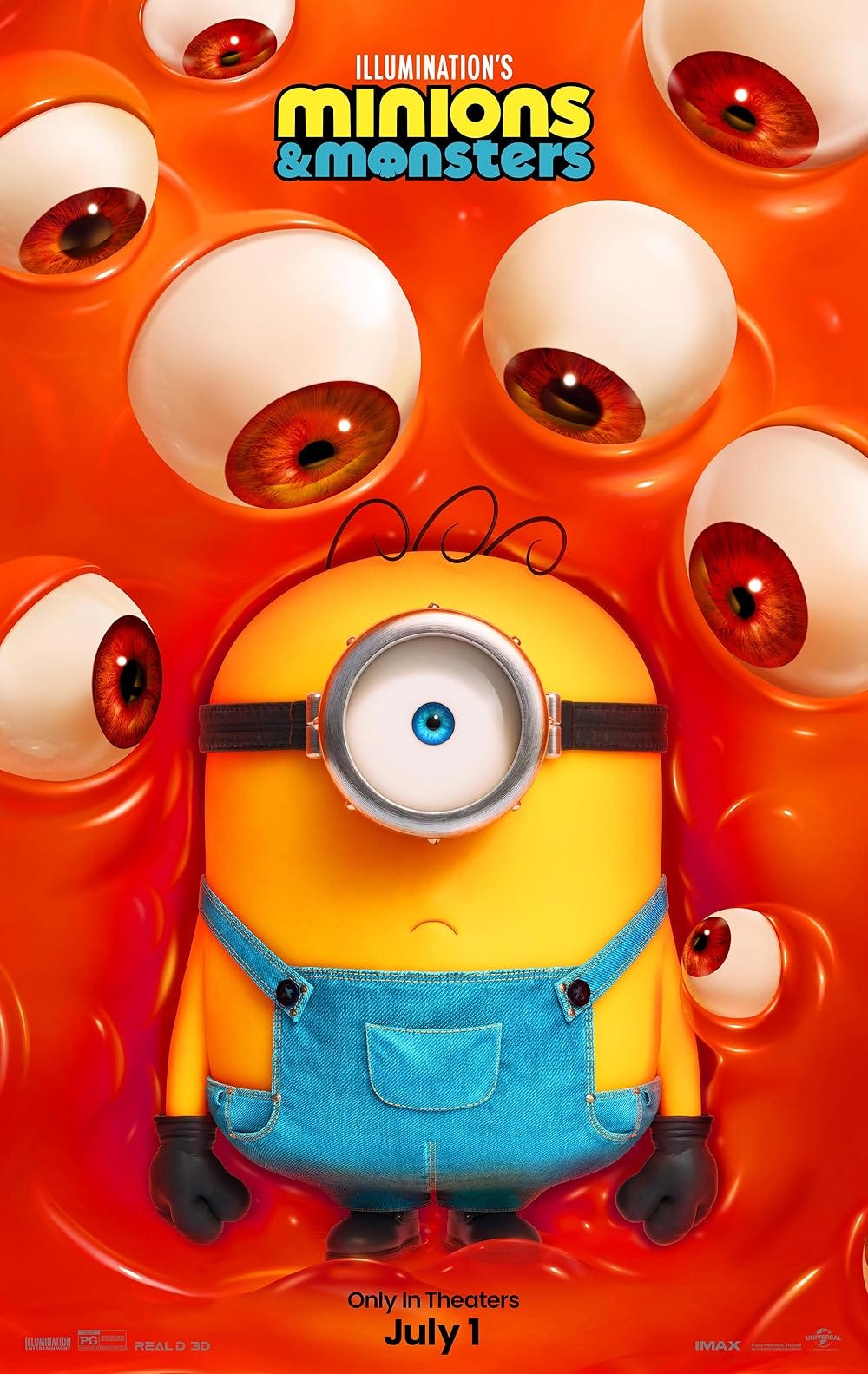
Minions & Monsters also has a recognizable arc, plot, and distinguishable characters. They aren’t necessarily complex or original, but they carry the film through its narrative beats with pace and structure. There are still narrative missteps, such as a side plot involving an alien robot named Dort (voiced by Jesse Eisenberg) that is as random as it sounds, and seems added more to pad the runtime to an even 90 minutes than to serve the story. The film’s Lovecraftian-Cthulhu monster Goomi (voiced by Trey Parker) is a forgettable addition, and only the all-eyed orange monster of the posters brings any sense of a memorable showdown, along with some funny commentary on a mass of “eyeballs” consuming all of Hollywood.
Minions & Monsters doesn’t reach the emotional depth or animation quality of the first two Despicable Me films, yet it is the closest that any of the turgid sequels have come. At the end of the day, it’s a rather enjoyable time at the movies, with jokes that land and film references galore for cinephiles to enjoy. As astonishing as it is to write: this Minions movie is worth the bananas of admission.