

Obsession
Curry Barker's Debut Lingers Long After the Credits Roll

Para leer en español, pulse aquí.
It has been more than a year since yours truly, Young Critic, moved from the US to Spain. While this has allowed me to flourish in certain ways, it has also constrained the publishing of reviews to the release schedule in Europe, which frequently means receiving smaller films months after their original US release. This has surprisingly proved one of the more difficult adjustments of moving to a new country for me, yet one learns to live with the differing schedule (I refuse to stoop to pirating films). However, my patience had not been tested on the level of the delay for Obsession (2025). The small horror film has become a box office and cultural phenomenon, arguably the cinematic event of the year. After months of critical discussion (while doing my best to stay away from spoilers) and old friends and family gushing about the experience of watching it, the film has finally arrived in Spanish theaters.
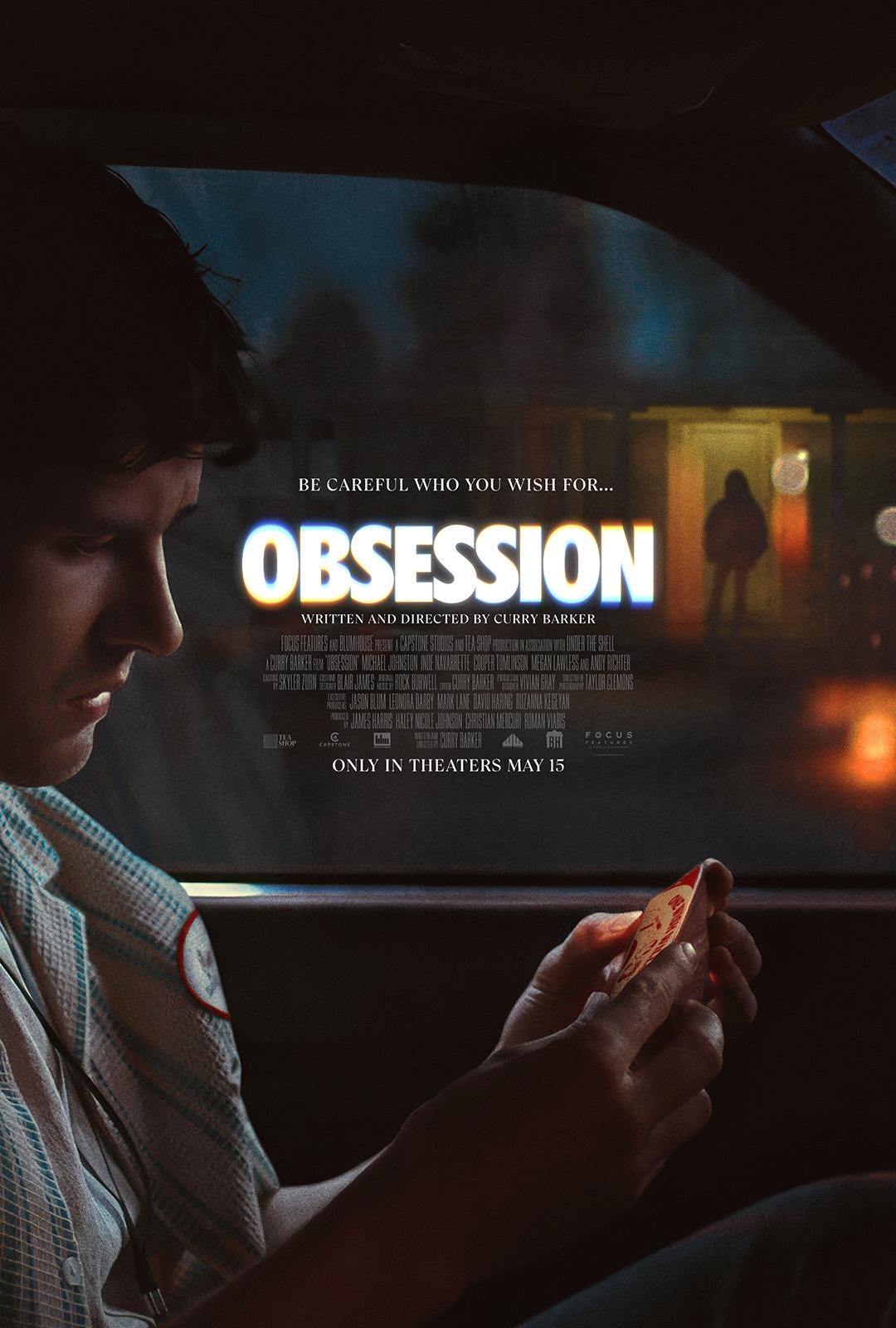
Obsession is the story of shy music store clerk Bear (Michael Johnston), who is secretly in love with his outgoing co-worker and friend Nikki (Inde Navarrette). When Bear stumbles upon an esoteric store while searching for a small gift for Nikki, he finds a One Wish Willow toy, which promises to make one wish come true if you break it. When Bear is unable to confess his feelings to Nikki on a drive home one evening, he breaks the stick and wishes for her to love him more than anyone else in the world. As tends to happen in a horror film, the wish comes true, but the lesson of “be careful what you wish for” soon comes to the fore. Nikki starts becoming infatuated and servile toward Bear, who at first is spooked, if also enjoying having his lifelong crush hanging on his every word. Yet Bear soon finds that Nikki’s infatuation is tinged with obsession and co-dependency that grows increasingly unnatural and creepy.
Obsession is yet another film this year from a director who started on YouTube, following Iron Lung (2026) by Mark Fischbach and Backrooms (2026) by Kane Parsons. Obsession is from the mind of Curry Barker, a relatively veteran aged 26 compared to Parsons’ 20. This young crop of filmmakers is not so much revolutionizing film through their craft, as talented as they are, but rather tapping into a cultural nerve that has made Gen Z the most moviegoing generation this year. It is a true cultural shift, one that is seeing original fare attended by audiences once again while mainstream franchises like Star Wars: The Mandalorian and Grogu (2026) and Supergirl (2026) are left in the dust. Who knew that to get young people to go to the movies, you should simply have young people make the movies themselves?
While Backrooms proved a gripping horror debut with an incredibly immersive quality, Obsession operates on many more levels, touching on a subject even more relatable to any young viewer: relationships. As with any great story, it can be read and enjoyed differently depending on which layer you engage with. The surface-level horror is gripping, unexpected, and genuinely off-putting in the best way, yet it is the deeper layer that truly rattled me, bringing echoes of personal experiences and friends’ relationships to the fore. Obsession shows how through small acts of emotional manipulation and guilt, Bear cedes his autonomy and personal space until it is too late and the escalation of threats and toxicity grows unbearable. What made me shiver were not the climactic violent scenes as much as the micro-toxicities: not being able to get out of bed at night, or love-bombing gifts that leave you feeling indebted to your partner. These are signs not of love, but of need and addiction, ones that indulging in only makes things worse and an exit even harder. It is those elements that echo most and are more likely to leave your stomach churning as you walk out of the theater.
Obsession can also be read through several other lenses. A feminist reading might see the domination of a female body by male desire as reflecting a great deal of the current state of America, particularly with Bear functioning as an empathetic yet recognizable incel stand-in. Another feminist reading might address the trend of tradwives, who purport to embrace a servile role to men in today’s society, and whom Obsession presents as manipulated and brainwashed while the real woman suffers on the inside. I could frankly write a dissertation on the different angles and readings I found hinted at within the film, which range from mental illness to Egyptian mythology (those cats and Bastet… just saying), and even the world of the subconscious and dreams. Clues are littered throughout that will keep you up at night piecing them together. I got home discussing the film and two pieces then clicked into place, remembering a twisted reading of “Hansel and Gretel” and discovering the message it was sending that sent a shiver down my spine.
Trying not to fall too far down the rabbit hole of deciphering the symbolism, it’s safe to say that Obsession is a rich text, one that Barker has crafted with an expert hand. His cinematic skills extend beyond the symbolic to the technically adept. His horror and suspense are built with real craft, earning his jump scares, and while he leans heavily on music to sustain his unsettling mood, it proves effective in the key moments. Most importantly, Barker crafts characters with depth and genuine stakes. Within the first ten minutes we grasp the history of these characters and mourn it when it begins to change. Bear is certainly a flawed man with manosphere-adjacent urges, but you never sense that he acts from malice, and this allows us to see a flawed, sympathetic, if ultimately selfish character. We are placed on his side and root for him to succeed, perhaps because we recognize a certain regret and selfishness of our own.
Made for just under $1 million, Obsession manages to look far better in its effects, makeup, and overall sense of dread than many films exponentially larger in scale. Barker largely achieves this through pure creativity, particularly in lighting. I was constantly unsettled by the simple choice of keeping much of Nikki’s face in shadow, with only her eyes glinting out in an otherwise ordinary conversation. The use of her face in shadow also works on a symbolic level, as a mask that this new Nikki wears, and as an unsettling way of keeping us guessing: is she awake? Is she menacing? Is she now just a silhouette to be possessed, perhaps in more ways than one? It is a showcase that creativity can never be bought, and that innovative brilliance is hard to constrain.
Working with a small budget, Barker relied on friends and newcomers for his cast. Johnston, is his roommate, and is great in the lead, letting us see Bear’s desperation and greed while still making us sympathize with him. Yet it is Navarrette who is the true standout, commanding the entire screen. Not only does the role of Nikki require the American actress to shift into exaggerated, heightened emotions and uncomfortable, messy scenes, she also delivers a screen presence that dominates even the scenes she isn’t in. Hers is not only a physical performance but an emotional one, too: Nikki is a torn person, caught between the real woman being hidden and the fantastical one conjured by Bear’s wish, and Navarrette manages to hold both simultaneously.
I’ve arrived late to the Obsession conversation, yet despite the impossible hype that had built over months of hearing about its cultural impact in the States, the film lived up to every expectation and then some. Richly written by Barker, expertly directed and crafted as his debut, and anchored by an indomitable performance by Navarrette, Obsession is a film that will haunt you less through its genuinely spooky images than through the echoes of your past relationships that seep into you as the credits roll and keep you obsessed about this film.
9.0/10
This review was originally published on Young Critic.
I think for cases like this it is absolutely okay to try decipher symbolism. In fact, I think that can make the conversation that much more rich, which is obviously what seems to be happening around the discourse for this film, evidently resulting in its success.